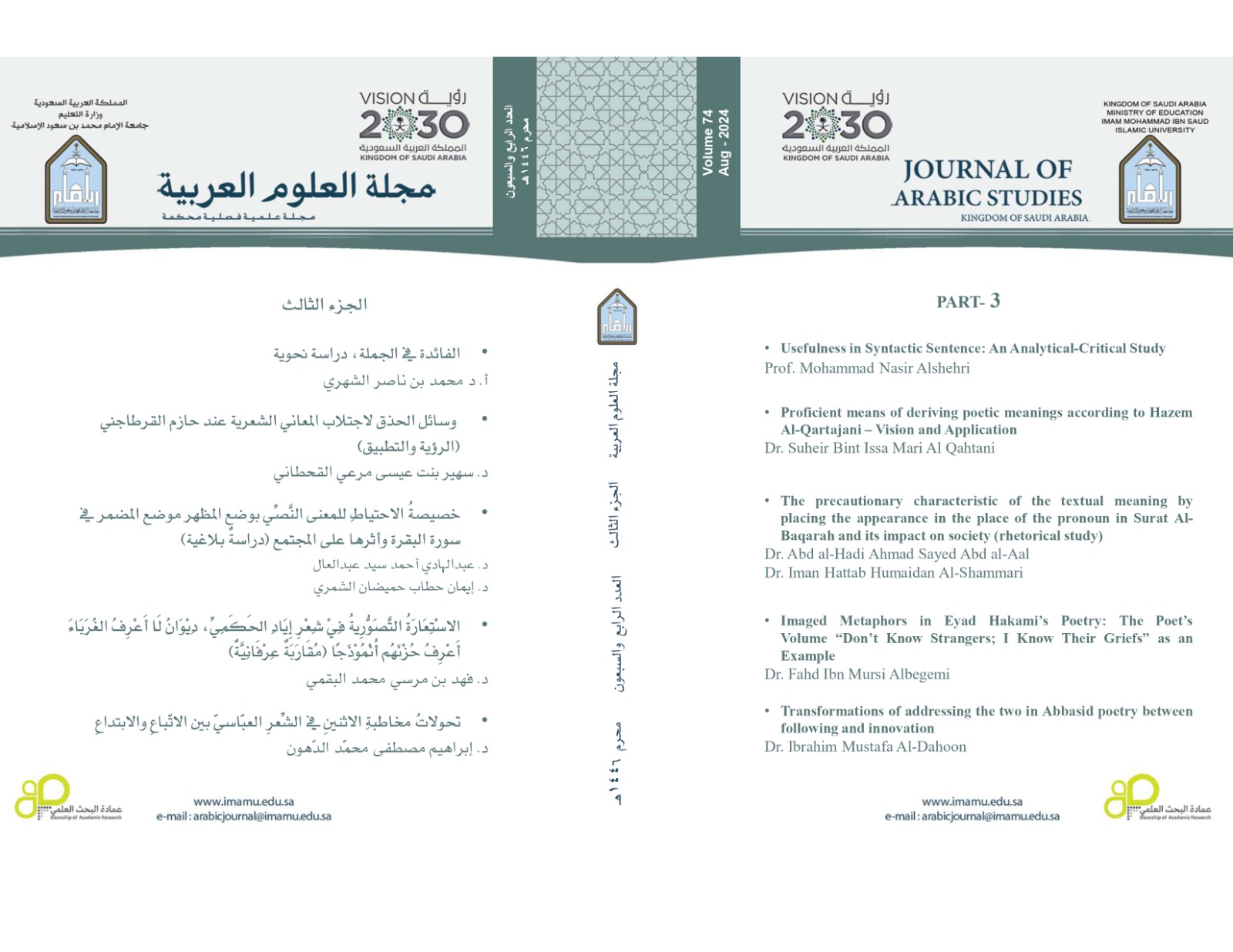

Hazem Al-Qartajani's Methods of Deriving Poetic Meaning: Vision and Application
Keywords:
Proficiency, Means, Acquisition, Intellectual Meanings, Hazem Al-Qartajani, poetic meaningAbstract
The excellence and elevated rank of poetry can only be achieved through the nobility of its meanings, the skill in selecting them, and the precision in realizing their intended purposes. Poetic meanings held a privileged place in the thought of Hazem al‑Qartajani, who developed a distinctive approach that considered the word even before its formulation. He therefore devoted careful attention to explaining the methods of expressing meanings and to the mastery of deriving them. He dedicated a chapter to this subject, outlining the means that lead to proficiency in deriving meanings, codifying specific rules and principles, and classifying degrees of mastery in clear and precise terms. He then applied his theoretical framework in his critical analysis of the poetic examples he cited.
This study, entitled Hazem al‑Qartajani’s Methods of Mastery in Deriving Poetic Meanings: Vision and Application, seeks to present these methods, emphasizing Hazem’s comprehensive perspective and the principles he established for deriving meanings and applying them. The research adopts a descriptive‑analytical methodology and is structured into an introduction, a preface, and four chapters: (1) the purposes that motivate the composition of poetry; (2) the ways in which meanings are related to one another; (3) the proper handling of intellectual meanings; and (4) the identification of meanings that are suitable for poetry and those that are not. The conclusion presents the key findings and recommendations, including: the consistency of al‑Qartajani’s rules for attaining mastery in meanings with the views of his predecessors; the importance of rhetoric in regulating the treatment of intellectual meanings; his distinctive focus on general principles in establishing rules for meanings; and the correspondence between his theoretical rules and the judgments and selections he applied to the poetic evidence he cited.